The Intentional Man
Getting dressed differently costs less than a dinner out and produces results you can see in the mirror the same day. It's the fastest signal — to yourself and to the world — that something has shifted. Everything else builds from here.
Start Here — Stage 1
Change your clothes first
The fastest, most immediate step you can take. Put on something clean and intentional today — and notice how it changes how you carry yourself before anything else has changed.
Stage 2
Groom with discipline
Skin, hair, and facial hair routines that take 10 minutes and make a permanent impression.
Stage 3
Move. Eat. Feel good.
Build a body you're proud of — not by chasing perfection, but by showing up consistently and eating like an adult.
Stage 4
Own your space
A man's environment reflects his mind. Clean it, organize it, make it somewhere worth coming home to.
Stage 5
Master your money
Build the foundation, avoid the scams, and learn to invest like an adult who plans for the next decade.
Stage 6
Go somewhere new
Travel as education, not escape. Go somewhere that challenges who you are.
Stage 7
Grow your mind and your skills
Books and therapy to understand your emotions, plus a few optional, higher-effort skills worth building — cooking, an instrument, a language — so you stop reacting and start becoming.
Stage 8
Make it last
Before you dive in
The exact pieces, in the exact buying order, with what each one unlocks — as a single page you can keep open while you shop. Free. We'll also let you know when new guides go live, nothing else.
Check your inbox — the checklist is on its way.
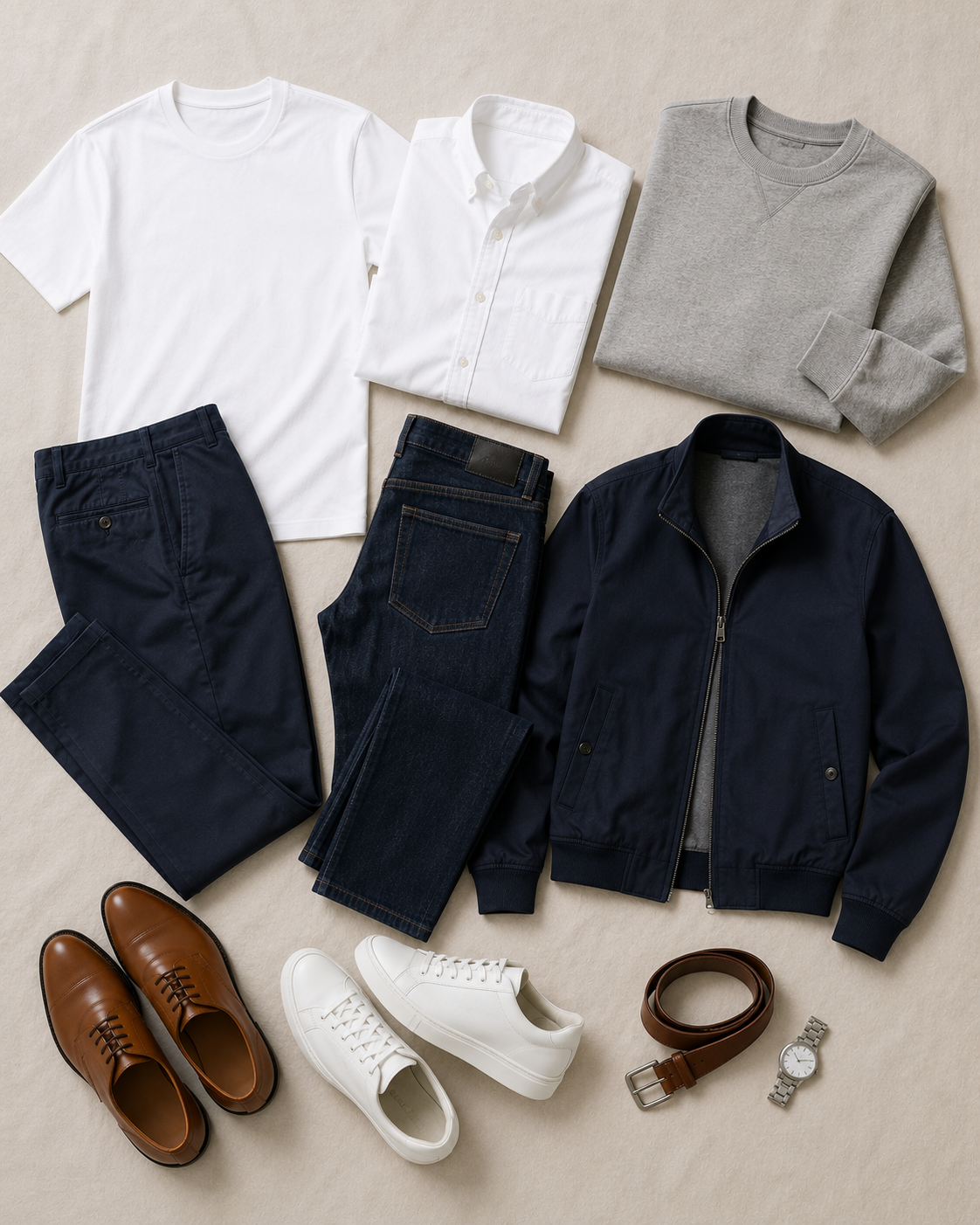
Nine pieces. Eight outfits minimum. We tell you exactly what to buy, in what order, and how to wear it. Three tiers — the same principles at every price point.
Vegan alternatives available throughout
Every leather item on this site has a high-quality vegan alternative listed alongside it — shoes, belts, bags, watch straps, and luggage. The same aesthetic standards apply: clean, minimal, logo-free, built to last. Look for the Vegan Alt note on any product that involves animal materials.
Fit varies piece to piece — here's how we handle it
Each piece on this site comes from a different base garment, and fit isn't standardized across them the way it would be from a single brand. Every product page carries its own measured size chart — that's the one to trust, not a general rule of thumb. As a starting point: fitted pieces (the Oxford shirts, chinos) run true to size; relaxed pieces (sweatshirts, jackets) run true to size for the intended look, with sizing up only if you want an exaggerated, oversized fit. If you're between sizes on anything, check that item's chart before you order — it's worth thirty seconds to avoid a return.
$20 – $45 per piece
You're just starting to care about how you look. These pieces won't break the bank, but they'll make you look like you have your act together. Perfect for testing your style before committing to more.
Every piece is part of our own line — built on the same standard cotton blanks (180–220 GSM) that fast-fashion brands use, but cut clean and finished without a single logo.
What this tier gives you
Don't try to buy everything at once. Follow this sequence — each purchase unlocks new outfit combinations.
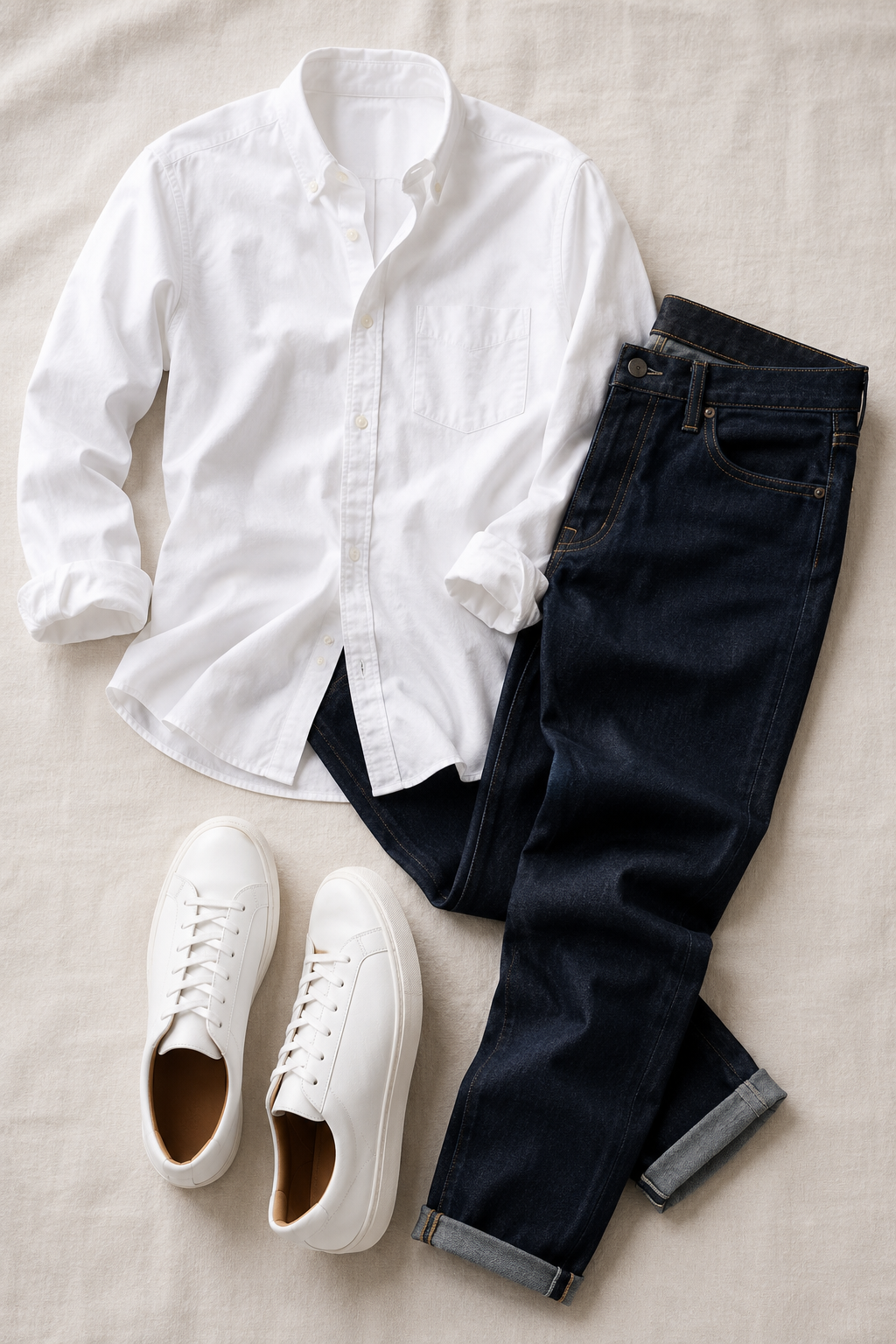
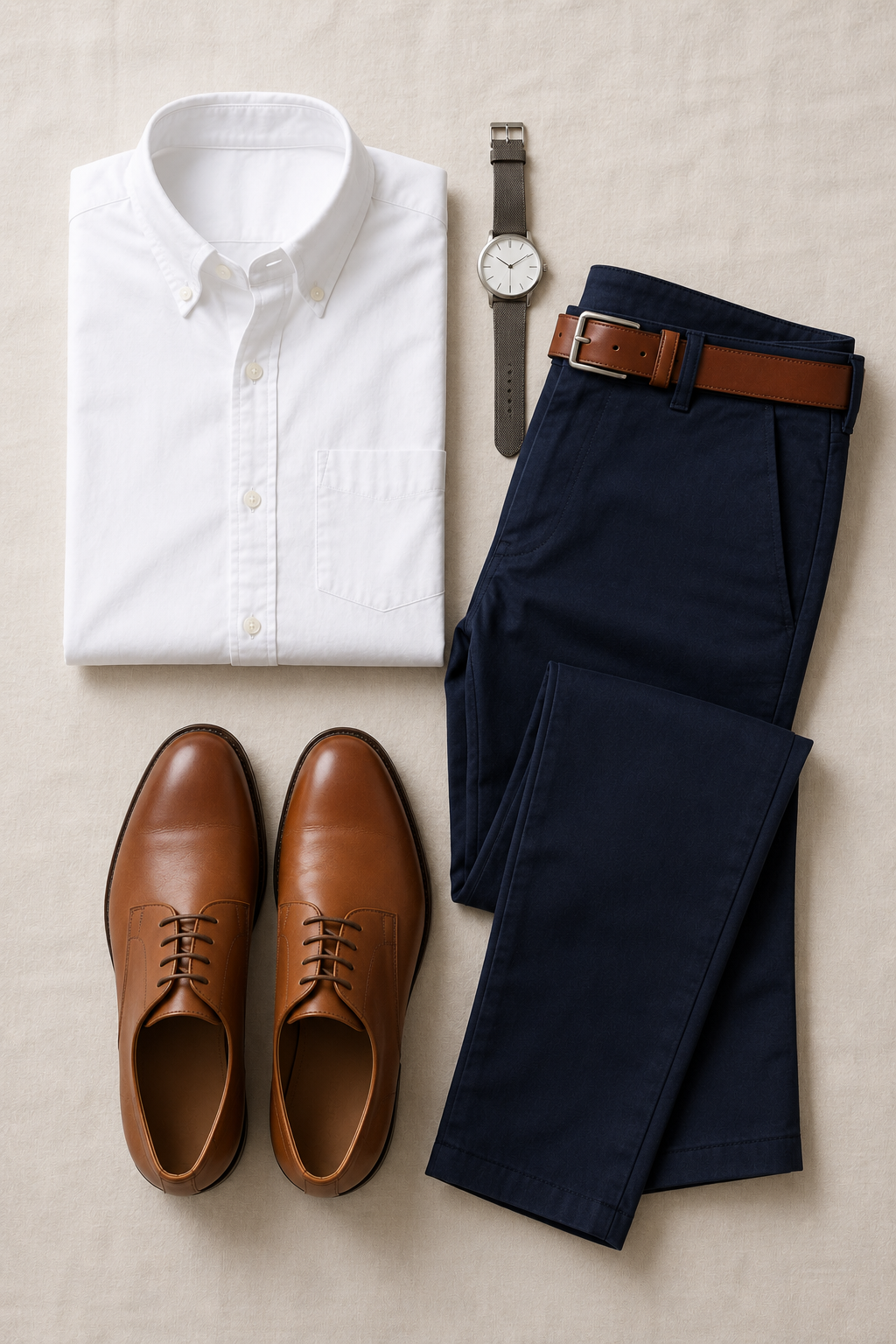
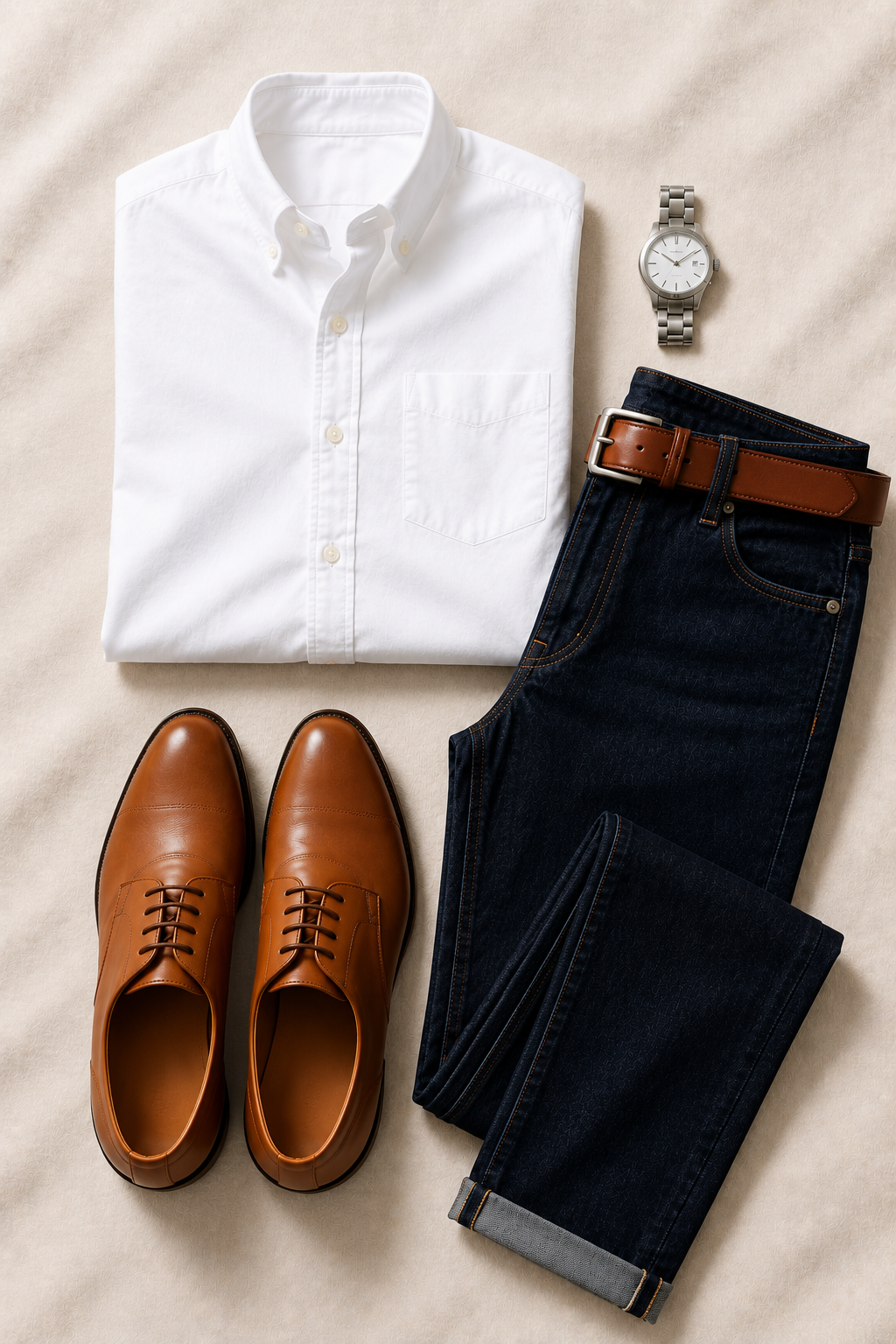
White Oxford shirt + Navy chinos
Your most versatile combination. Dressable up or down immediately. This single pairing creates 4 looks on its own.
White leather sneakers + Brown leather belt
Clean footwear transforms any outfit. The belt starts your accessories game — match it to your shoes always.
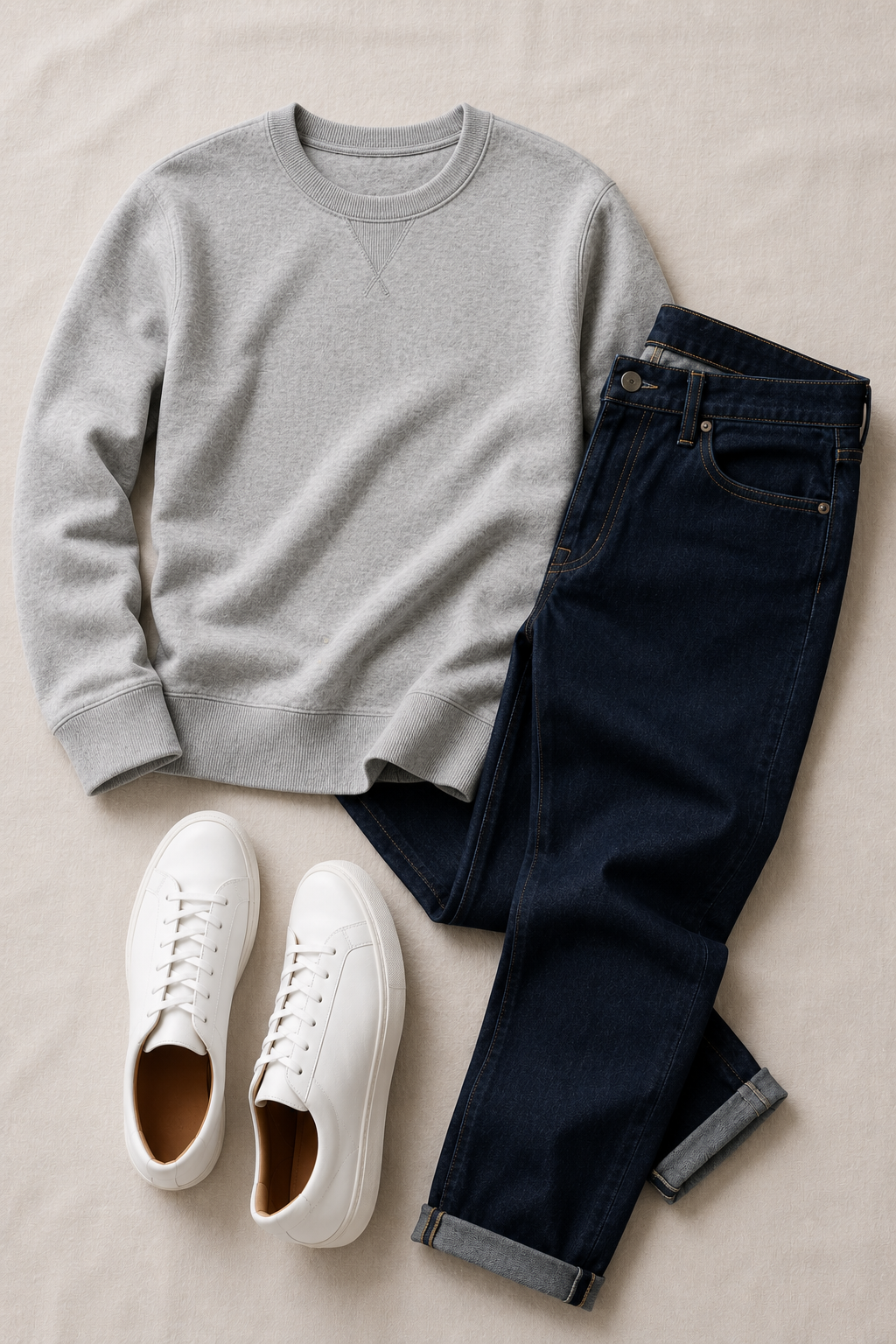
Gray crew-neck sweatshirt + Dark wash jeans
Your casual anchor. Adds a smart-casual register and multiplies combinations with your shirt and sneakers.
Navy Harrington jacket
The outerwear that works over everything you've bought. Instantly elevates any combination beneath it.
Simple silver or matte-black watch
One watch. Not flashy. This is the detail that shows you're paying attention. Rounds out every outfit.
Tan Derby shoes or Chelsea boots
Your formal-capable footwear. One pair that handles job interviews, dinners, and smart-casual occasions.
Tops
White Oxford Shirt
Plain, button-down collar, no logo. Tuck or untuck. Works with everything.
~$35
Bottoms
Navy Slim Chinos
Tapered fit, not skinny. Ankle length. The most versatile trouser you can own.
~$40
Tops
Gray Crew-Neck Sweatshirt
Midweight, no graphics. Heather gray only. Pairs with jeans, chinos, and everything else.
~$30
Bottoms
Dark Wash Straight Jeans
Dark indigo, no distressing, no fading. Dresses up far more than you'd expect.
~$45
Outerwear
Navy Harrington Jacket
Lightweight, clean cut. The single outerwear piece that works year-round in mild weather.
~$60
Footwear · Affiliate
White Leather Sneakers
Clean, no bold branding visible. Keep them spotless — dirty sneakers ruin everything else. Footwear isn't part of our own line — we link you to brands that already do this well.
~$55
Vegan Alt
Veja Campo Chromefree or Oliver Cabell Low 1 in synthetic. Both use plant-based or synthetic uppers with no animal glues. Visually identical to leather — clean, white, minimal. Veja ~$150, Oliver Cabell ~$108.
Footwear · Affiliate
Tan Derby Shoes
Your smart shoe. A plain toe Derby in tan leather handles every dressed-up occasion. Linked out to specialist footwear brands — not part of our own line.
~$75
Vegan Alt
Will's Vegan Store Derby or Nae Vegan Shoes Oxford. Both brands specialize in dress shoes with microfibre uppers and rubber soles — clean lines, tan or cognac colorways, no compromise on look. Will's ~$120, Nae ~$90.
Accessories · Affiliate
Brown Leather Belt
Plain buckle, no logo. Match to your shoes. This rule alone lifts your look immediately. Leather goods are linked out, not part of our own line.
~$25
Vegan Alt
Brave GentleMan Vegan Belt or Matt & Nat Strap Belt. Microfibre or recycled material, plain buckle, tan or brown colorway. Apply the same rule: match exactly to your shoes. ~$30–$45.
Accessories · Affiliate
Simple Steel Watch
Clean dial, leather or mesh strap. No oversized case. The detail that says you're paying attention. Watches are linked out to specialist brands, not part of our own line.
~$60
Vegan Alt — Strap
Specify a NATO fabric strap or stainless mesh bracelet when ordering — both are naturally vegan, look sharp, and suit the same clean dial. Brands like Skagen and Nordgreen offer plant-based or mesh strap options at this price point.
Every combination below uses only the pieces above — in the order you bought them.
Smart Casual
The Off-Duty Edit
Business Casual
The Meeting Look
Weekend
The Saturday Standard
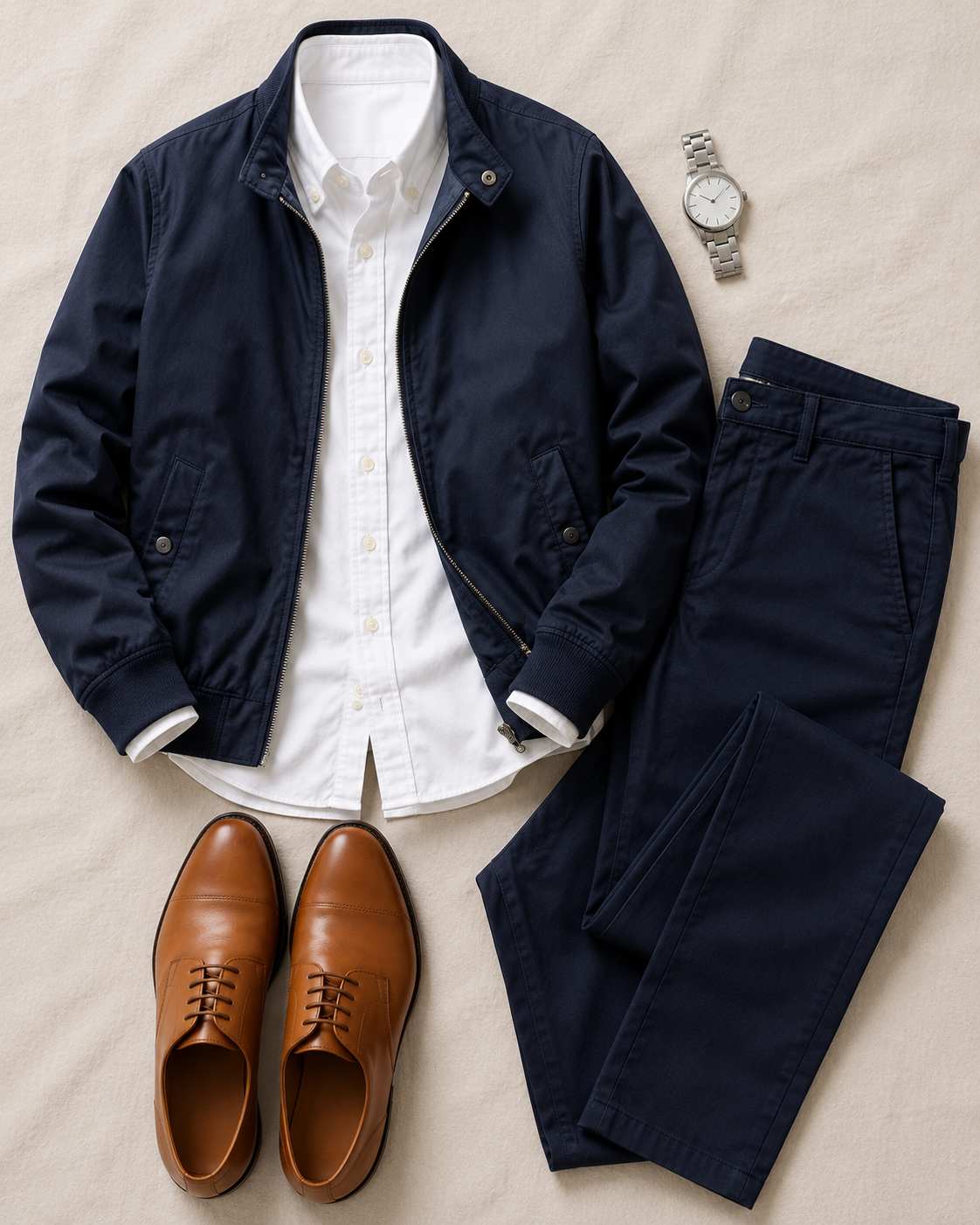
Layered Smart
Layered & Put Together
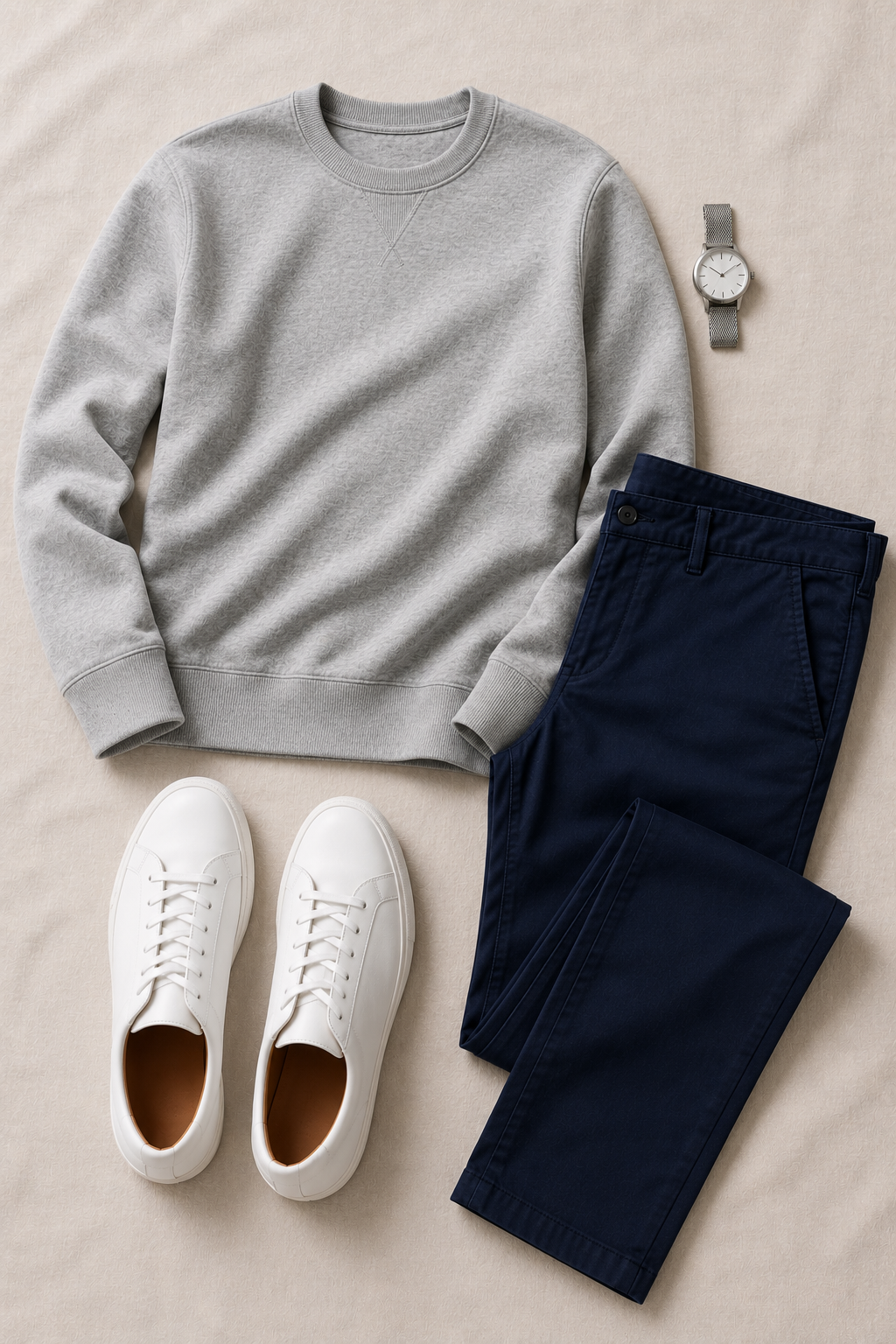
Casual Friday
The Easy Wind-Down
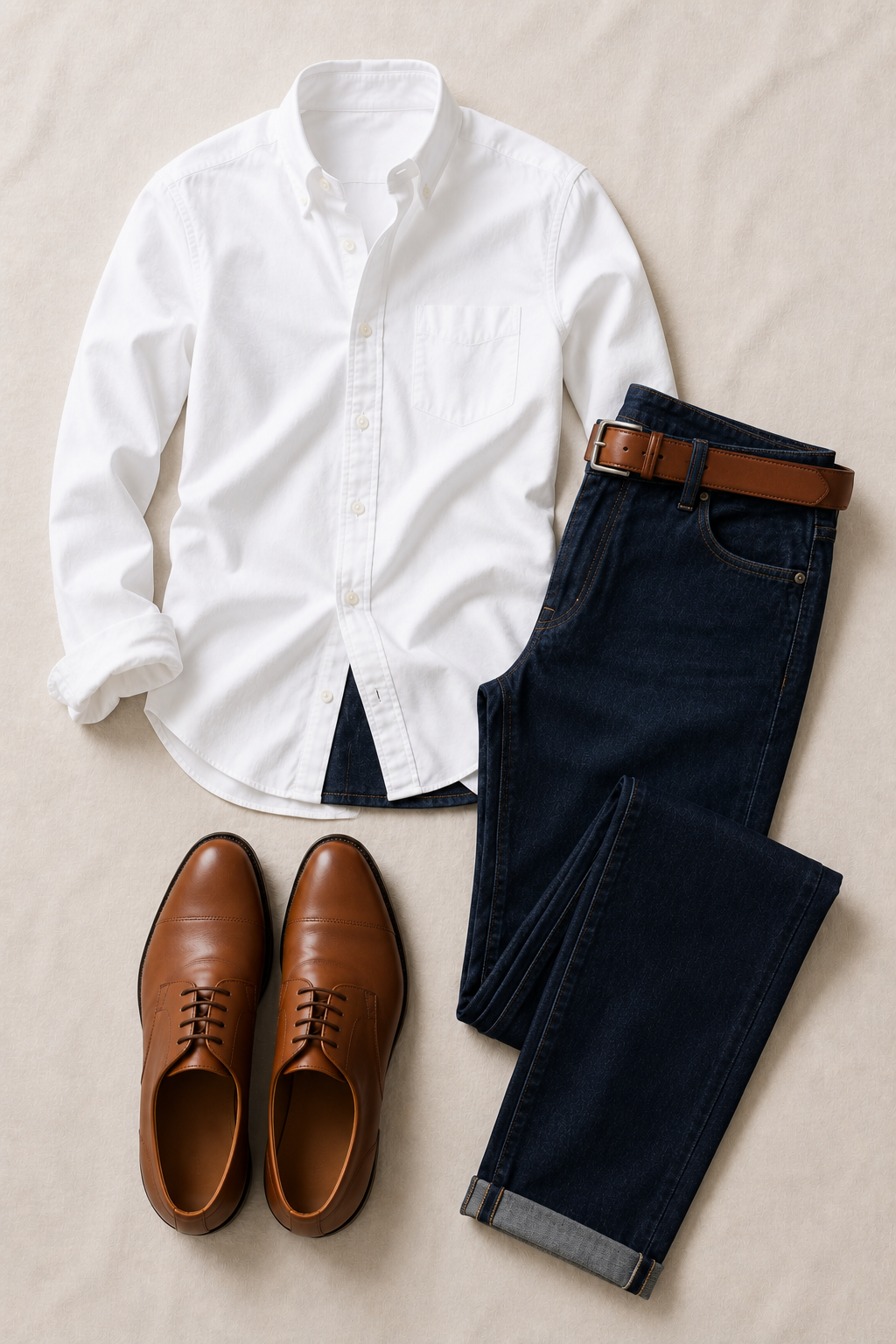
Dressed-Up Weekend
The Brunch Order
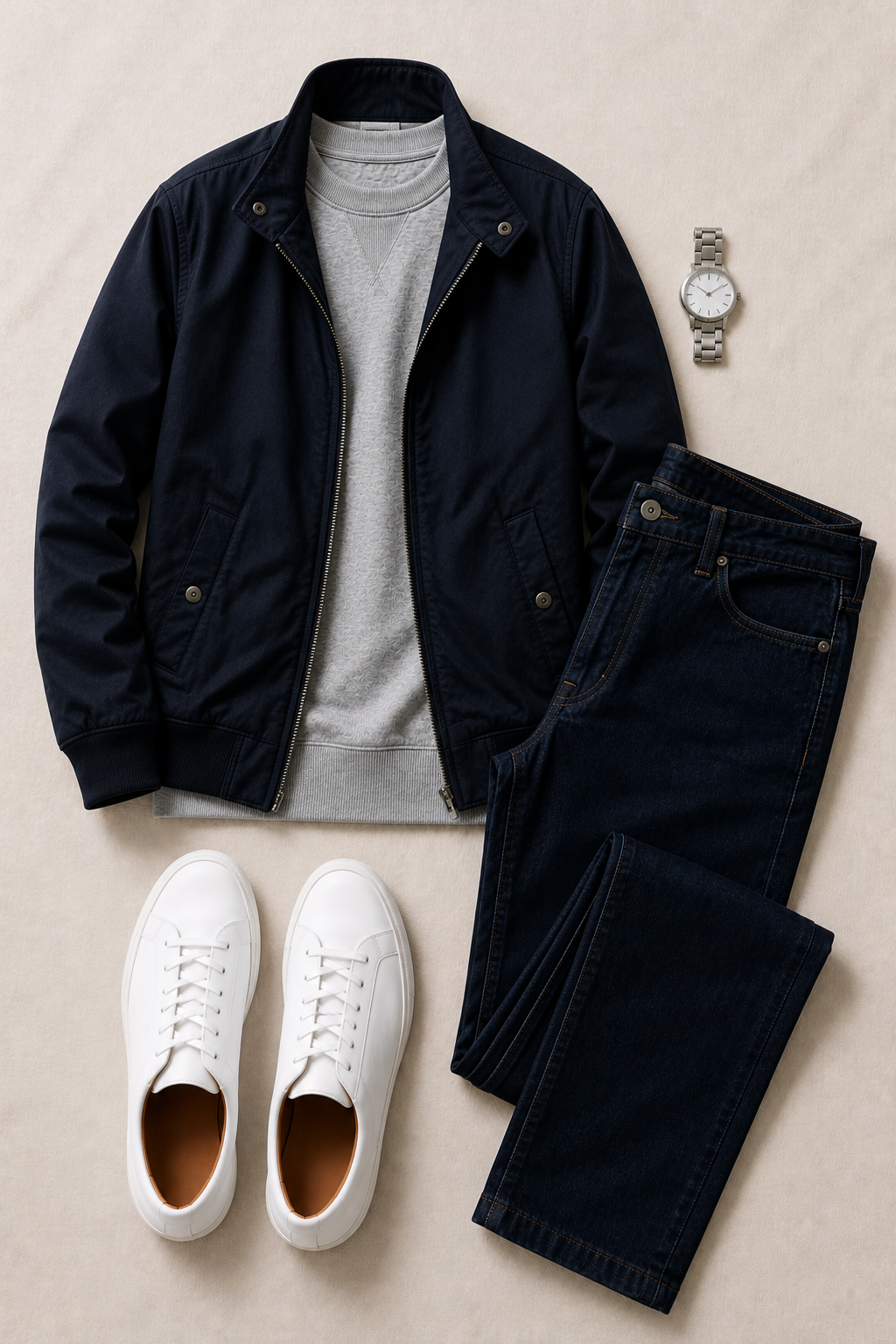
Cold-Weather Layer
The Commute
Formal-Capable
The Interview
$45 – $90 per piece
You've tested what works. Now you're replacing fast fashion with pieces built to last years, not months. Heavier fabrics, better construction, fewer pieces — but each one earns its place.
This tier is built on our premium blank line — 280–340 GSM heavyweight cotton, double-stitched seams, and proper drape. The difference is in your hands the moment you pick a piece up.
The upgrade you'll notice
Replace entry pieces one at a time. Don't buy everything new at once — upgrade what you wear most first.
Heavyweight Oxford shirt — 340 GSM brushed cotton
The piece you wear most. Heavier fabric drapes better, creases less, feels noticeably different the moment you put it on.
Heavyweight crewneck sweatshirt — 340 GSM brushed fleece
The fabric upgrade you'll feel immediately. Holds its shape after dozens of washes instead of going thin and baggy.
Garment-dyed crewneck jumper — navy or camel
Garment dyeing gives a richer, more even color than standard piece-dyed knitwear, and softens with every wash.
Tailored chinos — heavyweight cotton twill
The cut difference alone makes this worth it. A properly tapered leg sits differently on your body than a fast-fashion fit.
Structured bomber or coach jacket
Heavier shell fabric and a cleaner cut than the entry jacket. The piece that finishes off a layered look.
$90 – $160 per piece
This is the ceiling of what we build to spec — the heaviest fabric, the cleanest construction, the most considered detailing we offer. It is not luxury. It's not bespoke tailoring, and it's not a hand-lasted shoe. It's the best version of a piece that can be ordered online and shipped to your door, at a price that doesn't require a trust fund.
Built on our top-tier blank line — 380 GSM heavyweight cotton, garment-washed for softness from the first wear, with woven labels and embroidered detailing instead of printed branding.
If you want true luxury — cashmere from a named mill, a hand-lasted shoe, a suit cut for your exact body — that's not something we'll ever sell you online, and you should be skeptical of any site that claims otherwise. That tier of quality lives in a fitting room, not a product photo. Find a tailor. Try the coat on. Feel the cloth in your hands before you pay for it.
What you're really buying
At this tier, patience is part of the process. Save, research, then buy with full confidence.
Heavyweight Oxford shirt — 380 GSM, garment-washed
The top of our shirt line. Heavier than the Mid tier, pre-washed so it's already broken in the day it arrives.
Heavyweight overcoat — structured shell, full lining
Our top outerwear build. A proper structured cut with a full interior lining, not just a shell.
Embroidered crewneck sweatshirt — 380 GSM brushed fleece
Our heaviest fleece, with an embroidered crest or wordmark instead of a printed graphic — the detail that signals real care.
Tailored trousers — heavyweight wool-blend twill
The closest cut we offer to a true tailored trouser, in our heaviest available trouser fabric.
Structured field jacket — waxed cotton shell
The piece that closes out the collection. Waxed cotton in our heaviest weight, built to take weather without falling apart.
A 10-minute daily routine. That's all. The right products, used consistently, make more difference than any single item of clothing.
Three steps. Morning and night. That's the entire routine. Don't overcomplicate it.
Gentle Facial Cleanser
Cerave or Cetaphil. Morning and night. Removes oil, sweat, and product buildup without stripping your skin.
Daily Moisturiser with SPF 30
Sun damage is the #1 cause of ageing. Every morning, after cleansing. Non-negotiable. Try Paula's Choice or La Roche-Posay.
Night Moisturiser
A slightly richer formula for overnight recovery. CeraVe PM Facial Moisturising Lotion is a proven option.
Lip Balm
Cracked lips undo everything else. Burt's Bees or Aquaphor. Keep one at your desk, one by your bed.
Choose a style and maintain it obsessively. Patchy scruff looks like you forgot. A clean line looks deliberate.
Quality Trimmer (Braun or Philips)
One trimmer with multiple guards. Use it every 3 days minimum to maintain clean edges and consistent length.
Safety Razor or Cartridge Razor
For clean-shaven days or neck/cheek line definition. A safety razor pays for itself in 3 months versus cartridges.
Shave Gel or Cream
Real shave cream (Proraso or Jack Black) makes a genuine difference. Not supermarket aerosol foam.
Beard Oil (if growing)
3 drops after showering. Keeps the beard soft, reduces itch, and prevents flaky skin underneath.
Find a style that suits your face shape and get it cut every 4–6 weeks. Product should enhance, not perform.
Matte Clay or Paste
For most styles: American Crew Fiber or Baxter of California Clay. Medium hold, matte finish. Looks natural and intentional.
Lightweight Pomade
For slicker, more polished styles. Reuzel Blue or Suavecito. Work through slightly damp hair for best result.
Sulphate-Free Shampoo
Wash 2–3x per week maximum. Daily washing strips natural oils. Your scalp will thank you within two weeks.
A good barber, booked regularly
Find one, stick with them, tip well. The relationship is worth more than trying a new place each time.
Fitness isn't about looking like someone else. It's about showing up, building strength, and feeling at home in your own skin. We'll give you a path — not a punishment.
You don't need to be lean to start. You don't need to hate your body to want to improve it. The men who get into lasting shape are the ones who build a consistent practice they enjoy — not the ones who white-knuckle a six-week program and quit.
Progress looks different for everyone. The goal here is health, energy, and feeling genuinely good — not a specific number on a scale.
You are not a before photo
Your body is where you live. Treat it with basic respect from day one — not as a project to fix before you deserve it.
Consistency beats intensity
Three moderate workouts a week for a year beats one brutal month every January. Show up. That's 90% of it.
Progress is non-linear
Some weeks you'll regress. Some months will be slow. That's not failure — it's what getting fit actually looks like.
Find something you'll do again
The best workout is the one you'll repeat. Gym, swimming, football, hiking — movement is movement. Pick what you'll actually return to.
Three levels — pick the one that honestly matches where you are right now. There's no shame in starting at zero. Starting is the whole point.
Just move. Every day.
A 20–30 minute walk daily. That's it. No gym required. The goal is to make movement a non-negotiable part of your day before adding any intensity. Most people skip this and burn out. Don't.
Add bodyweight fundamentals
3x per week: 3 sets each of push-ups (as many as you can), bodyweight squats (15–20), and a plank (30 seconds). Don't push to failure. Stop when your form breaks down.
Introduce the gym or resistance
3x per week: Goblet squat, dumbbell bench press, dumbbell row, overhead press. Light weight, clean form. Ask a trainer for a 30-minute technique session — it's worth every penny. Focus on full range of motion, not how much you're lifting.
Build the habit, not the physique
Increase weights gradually. Add a 4th session if you feel ready. The goal by week 12 isn't a transformation — it's that going to the gym feels normal. That's the actual win.
Audit your form, not your ego
Drop the weight on your main lifts by 20% and rebuild from scratch with clean technique. Record yourself from the side. Most men with "some experience" have built bad habits — this week breaks them.
A/B split, 4 days per week
Day A: Squat, bench press, barbell row. Day B: Deadlift, overhead press, pull-ups or lat pulldown. Progressive overload — add a small amount of weight or one extra rep every session. Track it in a notebook or app.
Add accessory work and conditioning
Superset your main lifts with a supporting movement (e.g. bench press followed by face pulls). Add 20 minutes of zone 2 cardio (a brisk walk or easy bike) on two off-days. This is where body composition starts to shift.
Structured programming — not vibes
If you're training regularly but not following a written program, that's the gap. Try 5/3/1 by Jim Wendler or GZCLP. Both are free, proven, and built for exactly this stage. Follow a program, don't improvise one.
Fix your weak points
What movement do you avoid? That's probably what you need most. Weak posterior chain (lower back, glutes, hamstrings) is extremely common in men who sit at desks. Add Romanian deadlifts, hip thrusts, and face pulls.
Cardio is not the enemy
Three 30-minute zone 2 sessions per week alongside your lifting. Improves recovery, heart health, and mood significantly. Running, cycling, rowing — all work. Pick one and be consistent.
No calorie counting required. No weird diets. Just the basics that every adult knows but most men don't actually do.
Not complicated. Not expensive. Just food that does something useful for your body.
Vegetables — at every meal
Half your plate, every plate. Broccoli, spinach, peppers, courgette — they're cheap, filling, and the single biggest gap in most men's diets.
Protein at every meal
Eggs, chicken, fish, Greek yogurt, lentils. Aim for a palm-sized serving per meal. Protein keeps you full and supports muscle — it's not just for gym bros.
Water — before you drink anything else
500ml when you wake up. Carry a bottle. Most men are mildly dehydrated constantly — it affects focus, energy, and appetite.
Whole foods you cook yourself
Learn five meals. That's genuinely all you need. Rice + veg + protein in different combinations covers most of your week. Pick up "Good and Cheap" by Leanne Brown — it's free to download as a PDF, built entirely around simple, healthy, no-skill-required meals, and it'll get you through the first month without a single complicated recipe.
Fruit as your default snack
When you want something sweet, reach for fruit first. It's not a compromise — it's just the grown-up version of the sugar hit you're after.
You don't need to eliminate anything. But these are the things that quietly undermine everything else you're doing.
Ultra-processed food as a default
Ready meals, fast food, crisps, packaged snacks. Not because they're "bad" — because they crowd out the things that actually fuel you.
Sugary drinks
Fizzy drinks, energy drinks, juices. Liquid calories don't fill you up. Swap for water, sparkling water, or black coffee.
Skipping breakfast then overeating at night
The most common pattern. Eat something in the morning — even something small — and your evening hunger becomes manageable.
Alcohol as a coping mechanism
A drink is fine. Drinking because you're stressed, bored, or anxious is a separate thing worth paying attention to.
Eating alone over a screen every meal
Eating without awareness leads to overeating. Even one meal a day eaten without your phone changes how you relate to food.
The supplement industry is worth billions because it sells hope in a tub. Almost all of it is unproven, overpriced, or redundant if you eat well. These two have the evidence. Everything else is noise — save your money.
Creatine Monohydrate
3–5g daily — any time, with water
The most studied supplement in existence. Improves strength, power output, and muscle recovery. It also has emerging evidence for cognitive function and mood. Plain creatine monohydrate — not "creatine HCl", not "buffered creatine". Buy the cheapest own-brand powder you can find.
✓ Backed by decades of research
Shop on Amazon →Daily Multivitamin
1 tablet daily — with food
Insurance against the gaps in your diet — not a replacement for real food. Most men are low in Vitamin D (especially in winter), magnesium, and zinc. A basic multivitamin covers all three. Centrum or a supermarket own-brand is completely fine. No need to spend more.
✓ Practical nutritional safety net
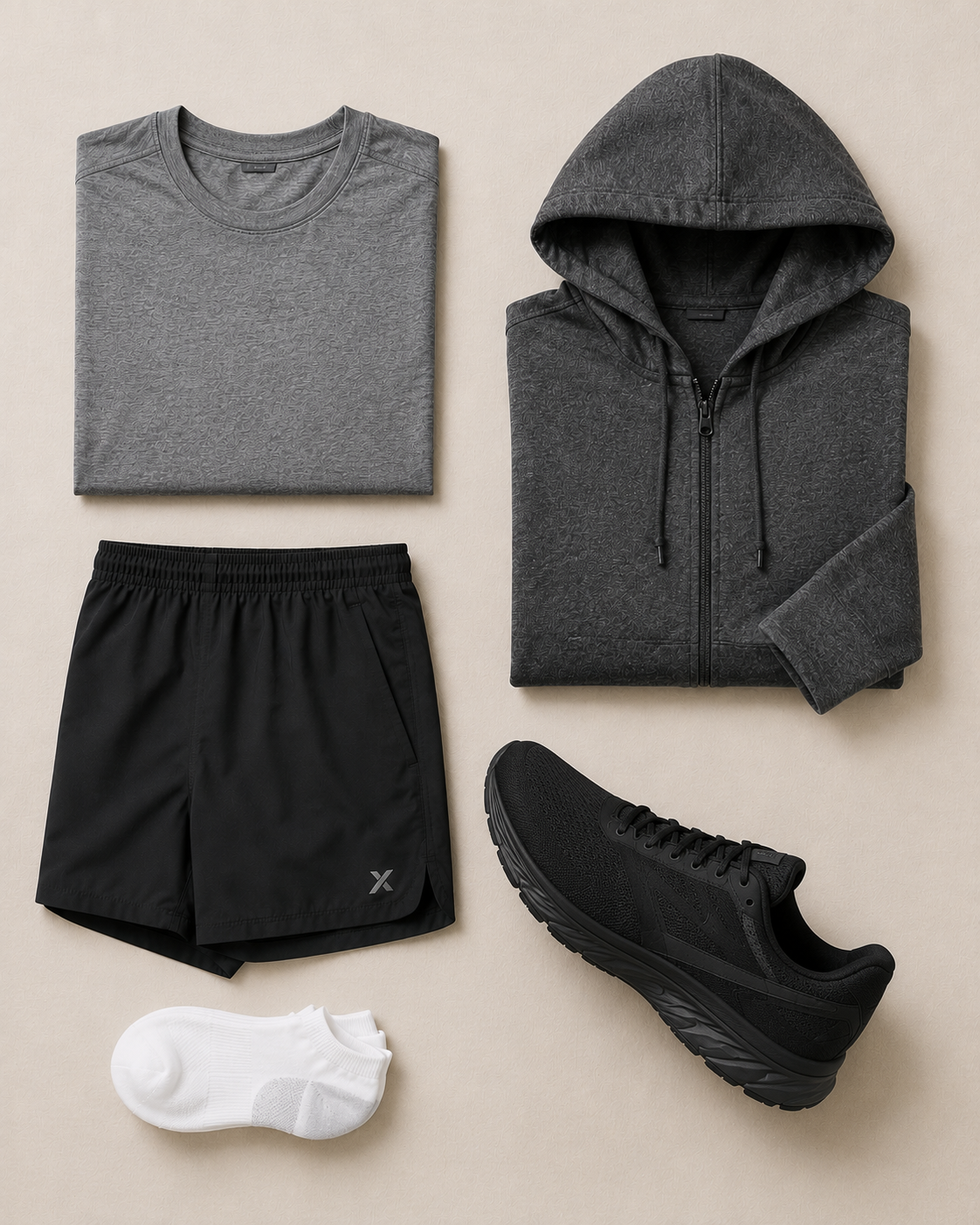
The same principles as your everyday wardrobe — clean, simple, no logos. You're there to train, not advertise. Functional fit matters: not so baggy you can't see your form, not so tight it restricts movement.
Tops
Plain T-shirt — fitted
Solid color, no graphic. A fitted tee lets you see whether your form is correct. Charcoal, white, navy, or black only.
Tops
Fitted tank — for warm sessions
A simple rib-knit or jersey tank. No cut-offs, no printed slogans. If it has writing on it, it shouldn't be in your bag.
Bottoms
Tapered training joggers
Fitted through the thigh, tapered to the ankle. Plain — no side panels, no color-blocking, no visible branding. Navy, charcoal, or black.
Bottoms
Training shorts — 7 inch inseam
Long enough to cover the thigh, short enough not to bunch. No basketball shorts. Plain color, no mesh panels, no logos.
Footwear
Flat-soled training shoe
For lifting: a flat shoe (Converse Chuck Taylor, Nike Metcon, or New Balance Minimus) gives a stable platform. NOT cushioned running shoes for squats or deadlifts.
Footwear
Running shoes — for cardio only
If you run, invest in a proper running shoe fitted at a specialist store. Don't use your lifting shoes to run. Keep them separate.
Layer
Plain quarter-zip or hoodie
For warming up or cooler gyms. Charcoal or navy. No graphics. Something you'd feel comfortable wearing outside without looking like you've just come from training.
Accessories
Lifting belt + wrist wraps
Only when you actually need them — not before you're lifting heavy enough to require support. A leather belt is a tool, not a badge. Don't wear one for bodyweight exercises.
The gym kit rule: if it has a slogan, a logo, or costs more than your monthly gym membership — put it back.
Big logo athletic brands charge you for the name printed across your chest. Our gym kit is built on the same heavyweight performance fabric, with the branding limited to a small woven tag — you're paying for the fabric and the cut, not a logo.
You can't think clearly in a cluttered room. You can't feel confident leaving a space you're embarrassed by. This isn't about interior design — it's about respect for where you live.
Before you buy anything, own these products and use them on a weekly schedule. Cleaning is a habit before it's a standard.
Multi-surface spray + microfibre cloths
For counters, desks, and surfaces. 10 minutes on Sunday morning changes the entire energy of a room.
Quality vacuum cleaner
A Dyson V8 or similar. Vacuuming weekly takes 15 minutes and instantly makes any space feel cared for.
Laundry hamper (with separate bags)
Dark/light separation from the start. Clothes on the floor are over. This is the physical boundary.
Bathroom cleaning kit
Toilet brush, limescale remover, and a squeegee for the shower. Weekly. The bathroom is judged most.
Candle or diffuser
Scent is underrated. A clean-smelling room feels different before it looks different. Cedar, sandalwood, or white tea.
Organizing without decluttering first is just tidying mess. Get rid of what you don't use, then store what you keep properly.
Desk cable management kit
Velcro ties and a cable box. Charging cables on your desk are visual noise — eliminating them immediately calms a workspace.
Wardrobe organizers + slim velvet hangers
Replace plastic hangers with slim velvet ones. Your wardrobe doubles in capacity and looks like it belongs to someone who cares.
Under-bed storage boxes
For seasonal clothing, spare bedding, or anything you need but don't use daily. Clears surfaces instantly.
Bathroom shelf or caddy
Every product in its place. A lined-up grooming shelf signals order to anyone who sees it — including you.
Desk tray or stationery organizer
One home for pens, chargers, keys, and cards. The "dump zone" that keeps everything else clear.
Fewer things, better things
A clear desk with one good lamp beats a cluttered desk with ten average items. Same rule applies to every surface in your space.
One accent color
Choose one color to run through your space — a cushion, a plant pot, a throw. Repetition creates the illusion of intention without effort.
A plant. Any plant.
A single living thing changes the feel of a room. Snake plant or pothos — practically impossible to kill, visually grounding, and air-filtering.
Two different kinds of growth live on this page. One is about understanding yourself better. The other is about getting visibly, measurably better at something new. Both outlast anything in your closet.
Mind
Emotional maturity isn't something that happens to you. It's something you build deliberately. These resources are the tools.
Books
Not self-help hype. These are books that give you frameworks for understanding yourself and relating to others.
No More Mr. Nice Guy — Robert Glover
The starting point for many men. Honest about the patterns that keep men stuck in people-pleasing and resentment.
The Way of the Superior Man — David Deida
On purpose, masculinity, and presence. Provocative but grounding for men questioning what they stand for.
The private journal of a Roman emperor. A masterclass in emotional discipline, written for no one but himself.
Permission to Feel — Marc Brackett
From Yale's emotional intelligence center. Practical and science-based — how to name, understand, and use your emotions.
Listen & Watch
Podcasts and channels built around genuine growth — not hustle culture, not empty affirmations.
Huberman Lab
Neuroscience applied to focus, sleep, stress, and relationships. Dense but rewarding. Start with the foundational episodes.
The Tim Ferriss Show
Long-form conversations with world-class performers. Particularly strong on mental health, habits, and unconventional thinking.
On Being — Krista Tippett
For men willing to engage with depth. Conversations on meaning, grief, love, and what it means to live well.
Waking Up — Sam Harris
Meditation without the mysticism. A secular, practical entry point into mindfulness for skeptical minds.
You service your car. You see a dentist. Therapy is the same principle applied to your mind. Every emotionally healthy man has a space to process — find yours.
Start with a therapist directory
Psychology Today, BetterHelp, or your GP. Ask specifically for CBT (Cognitive Behavioral Therapy) or ACT (Acceptance & Commitment Therapy) to start.
Learn to name what you feel
Most men operate with 3 emotional words: angry, fine, stressed. The "Feelings Wheel" by Dr. Gloria Willcox expands that vocabulary in a single page.
Journalling — 5 minutes a day
Not a diary. Just three prompts: What am I feeling? What triggered it? What would I choose to do about it? That's emotional maturity in practice.
Understand your attachment style
Read "Attached" by Amir Levine. Understanding whether you're anxious, avoidant, or secure explains more about your relationships than any dating advice ever will.
Optional
Travel already delivers most of what's below — new environments, new people, real discomfort — for a long weekend's effort. Cooking, an instrument, and a language ask for months of unglamorous repetition before any of it pays off. None of this is required. Skip it entirely if Travel already covers the itch. Don't skip it if one of these three has been quietly on your list for years.
Skills
Spreading yourself across all three guarantees you finish none of them. Pick whichever one has been nagging at you the longest, and ignore the other two until it sticks.
Cook five meals from memory
Not a cuisine. Not a Pinterest board. Five meals you can make, confidently, for someone else, without a recipe open on your phone. Start there before anywhere else.
Salt, Fat, Acid, Heat — Samin Nosrat
Teaches the logic behind cooking instead of recipes to follow blindly. One book, read once, used for years.
Pick up an instrument
Guitar and piano have the gentlest learning curves and the most free teaching material online. You need 15 minutes a day, not talent.
Learn a language
Even broken Spanish or French changes how you travel and who you end up talking to. 15 minutes a day with an app beats a textbook you'll abandon by week two.
The only kitchen kit worth owning before you start: one chef's knife, one cutting board, one heavy skillet, one wooden spoon. Everything else is a Tuesday-night impulse buy you won't touch again.
The only extras worth buying alongside a beginner guitar or keyboard: a clip-on tuner, a strap, and a handful of picks if it's a guitar. Skip lessons, stands, cases, and anything else until you know you'll actually stick with it.
Financial literacy isn't taught in school and rarely modeled at home. But getting your money sorted — even modestly — changes your relationship with stress, confidence, and freedom more than almost anything else.
In order. Don't invest a penny until steps 1–3 are solid. This sequence matters.
Know where your money goes
Track your spending for one month — every transaction. No judgment, just data. You cannot manage what you don't measure. Use a free app like YNAB, Copilot, or just a spreadsheet.
Build a £/$ 1,000 emergency fund
Before anything else. This is not savings — it's insurance. It stops a car repair or medical bill becoming debt. Keep it in a separate account you don't touch.
Pay off high-interest debt
Credit cards at 20%+ APR, buy-now-pay-later arrears, payday loans. Pay the highest interest rate first, minimum payments on the rest. No investment returns more than 20% guaranteed — so paying this debt IS your investment.
Grow the emergency fund to 3 months' expenses
Three months of rent, food, and bills in a high-interest savings account. This is your freedom buffer. It's what lets you leave a bad job or handle a crisis without panic.
Get your employer pension match (if available)
If your employer matches pension/401k contributions, contribute at least enough to get the full match. That's a 50–100% instant return on your money. Not doing this is leaving free salary on the table.
Now invest — simply and consistently
A low-cost index fund (S&P 500, global tracker, or a Stocks & Shares ISA in the UK). Set up a monthly automated contribution and ignore it. Time in the market beats timing the market. Every time.
A simple rule set that changes how money feels within 60 days.
The 50/30/20 baseline
50% of take-home pay on needs (rent, food, bills). 30% on wants. 20% to savings or debt. This isn't a rigid rule — it's a starting point to understand your proportions.
Automate savings on payday
Move savings to a separate account the moment you're paid. Not at the end of the month from what's left — on payday. You can't spend what isn't there.
Spend more on fewer things
Buy a $90 item that lasts ten years. Don't buy ten $9 items that fall apart in one. This applies to clothes, tools, cookware, furniture. Quality over volume, always.
Audit subscriptions quarterly
List every recurring charge. Cancel anything you haven't actively used in the last month. Most men are paying $50–$150/month in forgotten subscriptions.
Learn the basics yourself
Read: "I Will Teach You to Be Rich" by Ramit Sethi (US) or "The Meaningful Money Handbook" by Pete Matthew (UK). Both are practical, jargon-free, and written for exactly this stage of life.
Get-rich-quick schemes are designed to exploit the same impatience and insecurity this site is trying to help you move past. Here's what to recognize and walk away from immediately.
Dropshipping "passive income" courses
The person selling the course makes money from the course — not the dropshipping. If it worked as well as they claim, they wouldn't need to sell you the course.
Crypto / NFT "opportunities"
Highly speculative, largely unregulated, and full of people whose profit depends on you buying in. If someone online is very excited about a coin, ask yourself why.
MLM / network marketing
The product is always secondary to recruiting more sellers. Over 99% of participants lose money. If the pitch involves your "network" more than the product — leave.
Trading signals / forex "mentors"
Anyone showing screenshots of profits and selling you access to their "strategy" for a monthly fee. Real traders don't need your subscription. The screenshots are fake or cherry-picked.
"Beat the algorithm" stock tips
Individual stock picking by amateurs consistently underperforms a basic index fund over 10+ years. If a random influencer could reliably beat the market, Goldman Sachs would have hired them.
Urgency and FOMO pressure
"This offer expires tonight." "Only 3 spots left." "I'm only sharing this with a few people." Good investments don't need a countdown timer. Walk away from anything that pressures a fast decision.
The most effective investment strategy for most people is also the most unglamorous one. It works precisely because it requires almost no decisions after the first one.
Low-cost global index fund
Vanguard FTSE Global All Cap, iShares Core MSCI World, or Fidelity Index World. Automatically diversified. Annual fees under 0.25%. Set up monthly contributions and stop looking at it.
✓ Do this first
ISA or 401k (tax wrapper)
In the UK: put your index fund inside a Stocks & Shares ISA — up to £20k/year tax-free growth. In the US: max out your Roth IRA first ($7k/year). The tax saving compounds just as powerfully as the investment return.
✓ Do this before a standard account
Individual stocks
Only once your index fund contributions are a habit, and only with money you could genuinely afford to lose. No more than 10–15% of your portfolio. Treat it like an education fund, not a retirement plan.
→ Only when the basics are covered
Property
A long-term goal worth planning for, not a shortcut. Save for a proper deposit (20%+), understand the full costs (stamp duty, maintenance, insurance), and don't rush it because you feel behind.
→ A goal, not a strategy
Keep Learning
Most financial content online is either selling you a course or selling you anxiety. This is neither — it's the same boring-but-effective philosophy this section takes on money, in newsletter and book form.
SocialReCap — Tyler Gardner
Weekly, free, and over 200,000 subscribers for a reason. A former financial advisor writing the kind of clear, jargon-free breakdowns he wishes the industry actually led with — no hot stock tips, no urgency, just clarity.
Real Wealth: Make Money Work For You — Tyler Gardner
Releasing December 2026. Two decades as an educator and financial advisor distilled into something you can finish in a weekend — aligning your money with your values rather than chasing someone else's number.
Travel is not a holiday from growth — it's one of the most direct routes to it. Exposure to different cultures, languages, and ways of living dismantles assumptions you didn't know you had. Go somewhere that makes you slightly uncomfortable. That's where the good stuff is.
Most men travel to switch off. That's fine — but travel can also switch things on. The man who has navigated an unfamiliar city alone, ordered from a menu he can't read, sat in a cathedral or mosque with no agenda, or struck up a real conversation with a stranger — that man has access to a part of himself that Netflix cannot reach.
You don't need much money. You need a passport, a bag, a loose plan, and the willingness to be a beginner again.
Five principles to travel by
Go alone at least once
Solo travel forces self-reliance, genuine decisions, and conversations you'd never have with a companion insulating you.
Walk before you book a tour
Pick a neighborhood on a map, walk into it with no agenda. Get lost on purpose.
Eat where locals eat
A meal at a local restaurant tells you more about a place than any museum. If the menu has photos, keep walking.
One screen-free day per trip
No photos, no maps, no checking in. This is the day you'll remember in ten years.
Write something when you get back
What surprised you. What made you uncomfortable. The reflection is half the value.
If you haven't traveled solo or internationally before, start somewhere accessible — good infrastructure, English spoken widely, genuinely rewarding. The goal is to build the confidence and habit of travel, not to endure a trial by fire. These cities all punch far above their effort level.
Western Europe
Lisbon
Portugal
One of Europe's most walkable, affordable, and genuinely beautiful cities. Trams, tiles, Atlantic seafood, and an unhurried pace that makes it easy to slow down and look around. Welcoming to solo visitors.
What it teaches
Learn that a city doesn't have to be loud to be alive Practice sitting in a café with nothing to do Fado music — the sound of longing and beauty combinedSoutheast Asia
Chiang Mai
Thailand
Deeply affordable, culturally rich, and genuinely welcoming to travelers who come with respect. The old city is walkable, the temples are extraordinary, and the food markets will fundamentally recalibrate what you think food can be.
What it teaches
Buddhism as a daily practice, not a philosophy seminar The correct way to treat people you don't share a language with How much less money you actually need to feel rich in the right contextNorth America
Mexico City
Mexico
One of the world's great cities — architecture, art, food, and neighborhoods of genuine character. Condesa and Roma are safe, walkable, and full of cafés, bookshops, and restaurants that will reset your expectations permanently.
What it teaches
How proximity to the US shaped — and didn't shape — a culture That a megacity can have neighborhood-level warmth Speaking even 20 words of Spanish changes the entire dynamicThese destinations ask more of you — culturally, socially, and logistically. They reward men who arrive with humility and curiosity. The discomfort is part of the education.
East Asia
Kyoto
Japan
Japan teaches restraint, precision, and care as cultural values — things directly aligned with this project. Kyoto in particular: temples, wabi-sabi aesthetics, the tea ceremony, and a relationship with craftsmanship unlike anywhere in the West.
What it teaches
That attention to detail is a form of respect, not obsession Silence as a social skill, not an awkwardness How to be a guest in a culture without assuming your way is defaultNorth Africa
Marrakech
Morocco
The Medina is disorienting by design — narrow alleys, no grid, sensory overload. Navigating it without a map builds a tolerance for uncertainty. The architecture, textiles, food, and hospitality traditions are deeply worth engaging with seriously.
What it teaches
That being lost isn't a problem to fix — it's part of being somewhere new Hospitality as a cultural commitment, not a commercial transaction Slowing down in heat — the afternoon rest as wisdom, not lazinessSouth America
Medellín
Colombia
One of the great urban transformation stories of the last 30 years. A city that rebuilt itself. The warmth of its people, the cable cars above barrio rooftops, the salsa, the coffee, and the mountains surrounding everything make it genuinely life-expanding.
What it teaches
How a city's history shapes its people's outlook That joy and hardship are not mutually exclusive Dancing as a social skill, not a performance — take a classNot extreme — just genuinely demanding. These are trips that require planning, physical effort, or a willingness to be far outside your comfort zone. They produce the clearest thinking and the best stories.
Southern Europe
Camino de Santiago
Spain · France · Portugal
A 500-mile walking route across northern Spain (the Frances route is the classic). Takes 30 days. You carry everything you need on your back, meet strangers who become meaningful, and have more time alone with your thoughts than you've probably ever had. It changes men.
What it teaches
What you actually need versus what you think you need How to have real conversations with strangers across language barriers That the body is more capable than the mind gives it credit forEast Africa
Nairobi + National Parks
Kenya
A safari isn't luxury tourism — in its proper form it's a confrontation with scale, wildness, and perspective. Combine it with time in Nairobi, which is genuinely one of Africa's most dynamic cities. A continent most Western men know almost nothing about deserves more than one story.
What it teaches
How small human problems look against an African horizon at dawn The specific bias and ignorance most Western men carry about Africa That "developing" is a condescending word for extraordinarySouth Asia
Rajasthan
India
India does not let you stay inside your own head. It is overwhelming, beautiful, chaotic, ancient, and impossible to reduce to a simple narrative. Jaipur, Jodhpur, Udaipur — a circuit through Rajasthan is one of the most visually extraordinary things you can do with three weeks and a willingness to surrender control.
What it teaches
That your definition of order and chaos is entirely cultural Hospitality from people with far less than you The feeling of being completely, productively overwhelmedSlow travel — staying two to four weeks in one place rather than hitting eight cities in ten days — produces something fundamentally different. You begin to understand the rhythms of a place rather than consuming its highlights. You become a temporary resident rather than a tourist. These are places worth that kind of time.
Eastern Europe
Tbilisi
Georgia
One of Europe's most underrated cities. Stunning Orthodox churches, Soviet-era architecture, ancient wine culture (they invented it), extraordinary food, and some of the most genuinely warm hospitality anywhere. Deeply affordable and deeply rewarding for the curious traveler.
What it teaches
That Europe's eastern edge is where the most interesting stories are Wine, bread, and cheese as cultural inheritance, not lifestyle marketing How to sit with strangers and eat for three hoursSoutheast Asia
Hội An
Vietnam
A lantern-lit ancient town on the central coast with extraordinary food, skilled tailors, quiet rivers, and a pace that actively slows you down. Spend three weeks: eat every morning at a market, cycle to the beach in the afternoon, and read in the evenings. This is the trip.
What it teaches
That doing less produces more — the slow travel proof of concept Vietnamese cooking as discipline and precision How quickly a place stops being foreign when you stop rushing through itSouthern Europe
Bologna + Emilia-Romagna
Italy
The region that gave the world Parmigiano-Reggiano, Prosciutto di Parma, Lambrusco, tagliatelle al ragù, and Ferrari. Bologna itself is a university city — young, affordable by Italian standards, full of covered walkways and extraordinary food culture. Italy as it actually lives, not Italy as it's marketed.
What it teaches
That pride in craft, food, and place is not nostalgia — it's identity How to eat lunch for two hours and not feel guilty about it The specific pleasure of understanding why something is made the way it's madeIt's more manageable than you think and more rewarding than you expect. The anxiety before departure is normal. It passes approximately 45 minutes after you land. Here's what actually helps.
Book the first night in advance
Just the first night. Knowing where you're sleeping when you land removes the only genuinely stressful variable. Everything after that can be loose.
Stay in a mid-range guesthouse, not a hostel dorm
A private room in a local guesthouse gives you quiet, safety, and owners who actually know the neighborhood. Worth every extra dollar for a first solo trip.
Tell someone your rough itinerary
A friend or family member. Not a moment-by-moment check-in — just "I'm in Lisbon this week, then Porto." Basic safety that costs you nothing.
Eat at the bar or counter
Solo dining at a table can feel exposed. The counter or bar is where the interesting conversations happen anyway. Bring a book if you need the social armor.
Learn five phrases in the local language
Hello, thank you, please, excuse me, and "do you speak English?" In the local language. This signals respect and opens more doors than you'd believe possible.
Don't over-plan
Two or three anchors per day maximum. The best travel experiences are unscheduled. Leave room for the morning you wake up and simply follow where the streets go.
Your bag is the first thing people see when you travel. The same principles apply as your wardrobe — clean, considered, no logos that shout. Quality hardware, neutral colors, built to last. You don't need much. You need the right things.
One bag if possible
A carry-on and a personal item covers most trips up to two weeks. Checking luggage adds time, cost, and anxiety. Learn to pack less.
Neutral colors only
Black, charcoal, olive, navy, or tan. Nothing with visible brand logos. You're not a walking advertisement.
Buy once, buy well
A good bag bought once is cheaper over ten years than three mediocre bags. Factor in the cost per year, not the sticker price.
Hardware matters
YKK zips, solid buckles, reinforced base. The fittings fail first on cheap bags. Check them before you buy.
Carry-On Suitcase
Monos Carry-On
Weekend trips · Short haul flights
Hard-shell polycarbonate in a matte finish. No loud branding. TSA-approved lock, silent spinner wheels, and a clean interior with compression straps. The aesthetic is right and the price is fair for what you get.
Medium Check-In
Rimowa Essential
1–2 week trips · Business travel
The standard against which other hardshell cases are judged. Grooved aluminum-look polycarbonate, multi-wheel system, and the kind of quality you feel the moment you pick it up. Understated and unmistakable without being flashy.
Hard-Shell Aluminum
Rimowa Original Aluminum
Long haul · A bag for life
Brushed aluminum with engraved grooves. Heavy but indestructible. The bag your son will inherit. It's not a status symbol — it's a considered object with a 70-year production history. Buy it once in your thirties and never think about luggage again.
Daily Backpack
Bellroy Classic Backpack
Day trips · Work · Urban carry
Clean minimal design with no external branding. Woven fabric, magnetic clasps, and a laptop compartment that doesn't broadcast itself. It looks at home in a meeting room and on a hiking trail equally — which is exactly what you want.
Travel Backpack
Aer Travel Pack 3
One-bag travel · 1–2 weeks
The cult one-bag travel backpack. 35L, fits as a personal item on most airlines, with a dedicated shoe compartment, clamshell opening, and clean all-black aesthetic. For the man who wants to travel with carry-on only and no checked bag, this is the answer.
Weekend Holdall
Bennett Winch Canvas Holdall
Weekend trips · The grown-up duffel
A proper waxed canvas holdall that improves with every trip. Bennett Winch makes bags that look as good at 60 as they do on day one. The brass hardware and unlined canvas tell a story through wear — and waxed canvas is naturally animal-free.
Also consider
Gunas New York tote or Matt & Nat Voyage Duffel for a fully vegan option at a lower price point. Recycled nylon or microfibre, clean hardware, no animal glues. ~$180–$280.
What to pack (always)
What to leave behind
The one-bag rule
This is the final stage — not because it's least important, but because it's what sustains everything that came before. The man who takes care of his things takes care of himself. Good clothes, treated well, are a decade-long investment. Most men ruin theirs in the first six months without realizing it.
"The most sustainable garment is the one you already own."
Proper care isn't complicated — it's mostly about doing less. Washing less often, at lower temperatures, with less heat in the dryer. The biggest cause of clothing wear isn't use — it's overwashing. If it doesn't smell, it doesn't need washing.
Oxford & Dress Shirts
Cotton · Linen
Trousers & Jeans
Denim · Cotton Twill · Wool
Knitwear & Sweatshirts
Merino · Cashmere · Cotton Fleece
Shoes & Boots
Leather · Vegan Microfibre · Suede · Canvas
Jackets & Outerwear
Wool · Cotton · Nylon
Belts & Watches
Leather · Vegan Microfibre · Metal · Fabric
Hang these
Fold these
The essentials kit
Every item above ships directly to your door. Cedar shoe trees, fabric shavers, lint rollers, clothes brushes, shoe polish kits, mesh laundry bags, and breathable garment bags — all available as a single order. No need to hunt different stores.
Most men ignore these. The ones who don't have clothes that last twice as long.
Wash at 30°C
Cool wash. Use for most shirts, chinos, and cotton basics. Saves energy and fabric.
Do not tumble dry
Hang dry only. Applies to most wool, linen, and structured garments. Ignoring this is how clothes shrink.
Hand wash only
Merino, cashmere, delicate fabrics. Cold water, gentle motion, no wringing. Reshape and dry flat.
Dry clean only
Suits, structured wool coats, anything with interfacing. Don't risk it — dry clean or don't clean it.
Iron on medium heat
Cotton and linen. Always iron inside-out or with a pressing cloth to protect the surface.
Do not iron
Synthetic fabrics, nylon, most gym kit. Use a steamer if wrinkled — it's gentler and often more effective.
Every man on this site is at a different point. Some are just noticing that how they dress is holding them back. Some are already working on themselves and need the external to catch up with the internal. Some are starting completely from zero.
It doesn't matter where you are. What matters is that you understand this: the clothes come first not because they're the most important thing — but because they're the most immediate thing. You can look like a man who has his life together before you actually do. And that look, worn consistently, has a way of closing the gap.
The wardrobe is the door. Walk through it. Then keep walking — into the gym, into therapy, into a savings account, onto a plane, into the man you're becoming. We've mapped the whole path. You just have to take the first step.